Business Consulting
Customer Relationship Management (CRM): The Complete Guide to Building Stronger Customer Relationships
Customer-Relationship-Management-(CRM)-The-Complete-Guide-to-Building-Stronger-Customer-Relationships-Chanakya-Consulting-Growth-Technology-Strategy-Automation-Intelligence
In today’s competitive business landscape, products and pricing alone are no longer enough to win customer loyalty. Organizations must understand their customers, personalize every interaction, respond quickly to inquiries, and build long-term relationships. Businesses that fail to manage customer interactions effectively often struggle with lost sales opportunities, inconsistent communication, and poor customer retention.
Customer Relationship Management (CRM) is a business strategy supported by technology that helps organizations manage customer information, streamline sales processes, improve marketing campaigns, and deliver exceptional customer service. By centralizing customer data in one platform, CRM enables teams to collaborate efficiently and make informed decisions based on real-time insights.
Whether you’re a startup looking to organize customer data or a large enterprise managing thousands of clients, implementing the right CRM solution can increase sales, strengthen customer relationships, improve employee productivity, and drive sustainable business growth.
What is Customer Relationship Management (CRM)?
Customer Relationship Management (CRM) is a combination of business practices, strategies, and software that enables organizations to manage interactions with current and potential customers throughout the customer lifecycle. CRM systems centralize customer information, track communication history, automate business processes, and provide valuable insights that improve sales, marketing, and customer support.
Instead of storing customer information across spreadsheets, emails, notebooks, and disconnected software, a CRM system provides a single source of truth that allows every department to access accurate, up-to-date customer data.
“A CRM system doesn’t just manage customer data—it helps businesses build lasting relationships that drive long-term growth.”
Why CRM is Important for Businesses
Every customer interaction matters. Without a centralized system, businesses often miss follow-ups, lose valuable customer information, and struggle to provide personalized experiences. CRM solves these challenges by ensuring every customer interaction is tracked and accessible.
Improves Customer Relationships
Maintain complete customer histories, personalize communication, and provide faster, more consistent service.
Increases Sales Performance
Track leads, manage opportunities, automate follow-ups, and close deals more efficiently.
Enhances Team Collaboration
Sales, marketing, and customer support teams access the same customer information from a centralized platform.
Supports Data-Driven Decisions
Comprehensive reporting and dashboards help businesses identify trends and improve strategic planning.
How Customer Relationship Management Works
CRM systems collect customer information from multiple channels—including websites, emails, phone calls, social media, live chat, and sales interactions—and organize it into a centralized database. This information is then used to automate workflows, improve communication, and support better business decisions.
Step 1: Capture Customer Data
Collect contact details, inquiries, purchase history, communication records, and customer preferences from various touchpoints.
Step 2: Organize Information
Store customer information securely within a centralized database accessible across departments.
Step 3: Automate Business Processes
Automatically assign leads, schedule follow-ups, send reminders, and trigger marketing campaigns.
Step 4: Analyze Customer Insights
Use dashboards and reports to understand customer behavior, sales performance, and marketing effectiveness.
Step 5: Strengthen Customer Relationships
Deliver personalized experiences that improve customer satisfaction, loyalty, and long-term retention.
Core Components of a CRM System
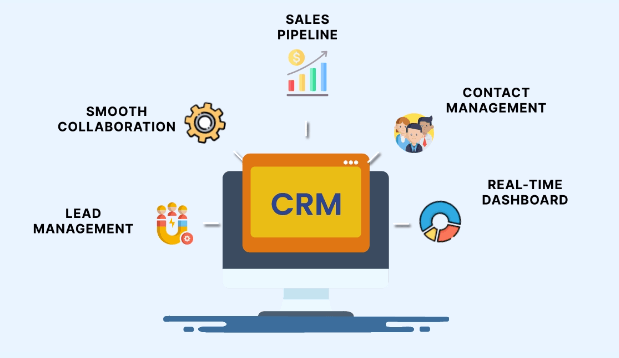
A modern CRM platform integrates several essential functions that support customer acquisition, engagement, and retention.
Sales Management
Manage leads, opportunities, sales pipelines, quotations, and revenue forecasting.
Marketing Automation
Plan campaigns, segment audiences, nurture leads, and measure marketing performance.
Customer Service
Track support tickets, resolve issues quickly, and improve customer satisfaction.
Analytics & Reporting
Generate dashboards and reports that provide actionable business insights.
Benefits of Customer Relationship Management
| Benefit | Business Impact |
|---|---|
| Higher Customer Retention | Build stronger customer relationships and improve loyalty. |
| Improved Sales Efficiency | Shorten sales cycles and increase conversion rates. |
| Better Customer Support | Resolve issues faster with complete customer information. |
| More Effective Marketing | Deliver personalized campaigns using customer insights. |
| Greater Productivity | Automate repetitive tasks and improve team collaboration. |
Key Features of Modern CRM Software
- Centralized customer database
- Lead and opportunity management
- Sales pipeline tracking
- Marketing campaign automation
- Email and communication tracking
- Customer support ticket management
- Workflow automation
- Reporting and analytics dashboards
- Mobile CRM access
- Third-party application integrations
- Task and activity management
- AI-powered customer insights
- Customer segmentation
- Document management
- Role-based access and security controls
Types of Customer Relationship Management (CRM) Systems
Not every business has the same customer management requirements. Modern CRM solutions are designed to support different business objectives, from improving sales productivity to analyzing customer behavior and enhancing collaboration across departments.
Operational CRM
Operational CRM focuses on automating customer-facing processes such as sales, marketing, and customer support.
- Lead management
- Sales automation
- Marketing campaigns
- Customer service
- Workflow automation
Analytical CRM
Analytical CRM collects and analyzes customer data to improve business decisions and identify growth opportunities.
- Customer analytics
- Sales forecasting
- Behavior analysis
- Performance reporting
- Business intelligence
Collaborative CRM
Collaborative CRM improves communication between departments by sharing customer information across teams.
- Shared customer database
- Cross-team collaboration
- Omnichannel communication
- Knowledge management
- Customer engagement
CRM vs ERP vs Marketing Automation
Although CRM, ERP, and Marketing Automation systems often integrate with one another, each serves a different purpose within an organization.
| System | Primary Focus | Typical Users |
|---|---|---|
| CRM | Customer relationships and sales | Sales, marketing, support teams |
| ERP | Business operations and resources | Finance, HR, operations, procurement |
| Marketing Automation | Lead nurturing and campaigns | Marketing teams |
CRM Implementation Roadmap
Implementing a CRM system requires careful planning, employee adoption, and continuous optimization. Following a structured roadmap improves the chances of long-term success.
Step 1: Define Business Objectives
Identify the problems you want CRM to solve, such as increasing sales, improving customer retention, or streamlining support.
Step 2: Select the Right CRM Platform
Choose a CRM solution based on scalability, integration capabilities, budget, security, and business requirements.
Step 3: Clean and Import Customer Data
Remove duplicate records, standardize customer information, and migrate accurate data into the CRM.
Step 4: Configure Workflows
Set up sales pipelines, lead assignments, approval processes, customer journeys, and automated notifications.
Step 5: Train Employees
Provide comprehensive training to ensure users understand CRM features and follow standardized processes.
Step 6: Monitor & Optimize
Continuously evaluate CRM performance using dashboards, reports, and customer feedback.
Common CRM Implementation Challenges
Poor User Adoption
Without proper training and leadership support, employees may not fully utilize the CRM system.
Poor Data Quality
Incomplete or duplicate customer records reduce CRM effectiveness and reporting accuracy.
Integration Challenges
Connecting CRM with ERP, email platforms, websites, and marketing tools may require careful planning.
Unclear Business Goals
Implementing CRM without measurable objectives often leads to low ROI and poor adoption.
CRM Best Practices
- Keep customer data clean, accurate, and regularly updated.
- Automate repetitive sales and marketing activities.
- Train employees continuously on CRM features and workflows.
- Integrate CRM with ERP, marketing automation, and customer support tools.
- Monitor CRM dashboards to measure performance and identify opportunities.
- Use customer insights to personalize communication and improve engagement.
- Review business processes regularly to maximize CRM value.
- Protect customer information through strong security and access controls.
Before vs. After CRM Implementation
Before CRM
- Customer data scattered across multiple systems
- Manual follow-ups
- Poor sales visibility
- Slow response to customer inquiries
- Limited reporting capabilities
- Disconnected teams
- Missed sales opportunities
After CRM
- Centralized customer database
- Automated lead nurturing
- Real-time sales dashboards
- Faster customer support
- Accurate forecasting
- Improved collaboration
- Higher customer satisfaction
CRM Use Cases Across Industries
Retail & E-commerce
Customer loyalty programs, personalized promotions, order tracking, and customer support.
Healthcare
Patient relationship management, appointment scheduling, follow-ups, and engagement campaigns.
Financial Services
Client portfolio management, financial advisory services, customer onboarding, and compliance.
Education
Student admissions, alumni engagement, inquiry management, and communication automation.
Popular CRM Software Solutions
Choosing the right Customer Relationship Management (CRM) platform depends on your organization’s size, budget, business objectives, and existing technology ecosystem. Below are some of the most widely used CRM solutions across industries.
| CRM Platform | Best For | Key Features |
|---|---|---|
| Salesforce | Large Enterprises | Sales automation, AI insights, analytics, customization |
| HubSpot CRM | Small & Medium Businesses | Marketing automation, contact management, sales pipeline |
| Microsoft Dynamics 365 | Microsoft Ecosystem | CRM + ERP integration, AI, reporting |
| Zoho CRM | Growing Businesses | Lead management, automation, omnichannel communication |
| Pipedrive | Sales Teams | Pipeline management, deal tracking, automation |
Key CRM Performance Metrics (KPIs)
Tracking CRM performance helps organizations understand whether their customer relationship strategy is delivering measurable business value.
| KPI | Why It Matters |
|---|---|
| Lead Conversion Rate | Measures how effectively leads become customers. |
| Customer Retention Rate | Shows how successfully businesses retain customers. |
| Customer Lifetime Value (CLV) | Estimates long-term revenue from each customer. |
| Sales Cycle Length | Measures the time required to close deals. |
| Customer Satisfaction (CSAT) | Evaluates customer experience after interactions. |
| Revenue Growth | Measures business growth supported by CRM initiatives. |
Emerging Trends in Customer Relationship Management
CRM technology continues to evolve with Artificial Intelligence (AI), automation, predictive analytics, and cloud computing. Modern CRM systems are becoming more intelligent, helping businesses deliver highly personalized customer experiences.
Artificial Intelligence
AI predicts customer behavior, recommends next-best actions, automates routine tasks, and assists sales teams with intelligent insights.
Predictive Analytics
Businesses can forecast customer needs, identify buying patterns, and prioritize high-value opportunities.
Conversational AI
Chatbots and virtual assistants provide 24/7 customer support while reducing response times.
Hyper-Personalization
CRM platforms use customer data to deliver personalized recommendations, offers, and communications.
Cloud CRM
Cloud-based CRM enables secure access from anywhere, automatic updates, scalability, and reduced IT costs.
Workflow Automation
Automation reduces repetitive work by managing follow-ups, approvals, lead assignments, and customer communications.
Frequently Asked Questions (FAQs)
What is CRM?
Customer Relationship Management (CRM) is a strategy and software system that helps businesses manage customer interactions, improve sales, automate marketing, and provide better customer service.
Who should use CRM software?
Businesses of all sizes—including startups, SMEs, and large enterprises—can use CRM software to organize customer data and improve business performance.
Can CRM increase sales?
Yes. CRM helps sales teams manage leads, automate follow-ups, track opportunities, and improve conversion rates through better customer insights.
Is CRM only for sales teams?
No. Marketing, customer support, finance, and management teams also use CRM to improve collaboration and customer experiences.
What is the biggest benefit of CRM?
The biggest advantage is having a centralized view of every customer, enabling personalized communication, stronger relationships, and better business decisions.
Conclusion
Customer Relationship Management is more than software—it’s a business strategy that places customers at the center of every decision. Organizations that successfully implement CRM can strengthen customer relationships, improve operational efficiency, increase revenue, and gain valuable insights for future growth.
As businesses continue embracing digital transformation, CRM platforms will become even more intelligent through AI, automation, and predictive analytics. Investing in the right CRM solution today positions organizations for long-term success in an increasingly customer-centric world.
Great businesses don’t just acquire customers—they build lasting relationships with them.
Ready to Transform Your Customer Relationships?
At Chanakya Consulting, we help businesses select, implement, and optimize CRM solutions that improve customer engagement, increase sales productivity, and drive sustainable business growth. From CRM strategy to full implementation, our experts support every stage of your digital transformation journey.
Published by Chanakya Consulting — Empowering businesses with Customer Relationship Management (CRM), Digital Transformation, Enterprise Resource Planning (ERP), Business Process Automation (BPA), Artificial Intelligence (AI), and strategic consulting solutions that drive measurable business growth.
OpenAI